Energy
Vision
Newmarket is a community that supports and preserves its semi-rural character while simultaneously embracing effective emerging technology, environmentally progressive strategies, and local business opportunities. The vision for the Town of Newmarket is that clean energy be affordable, reliable and sustainable and is used efficiently by the Town and residents. Newmarket’s quality of life and public health will be improved from clean and renewable energy generation. Newmarket’s energy policies will play a significant role in achieving this vision.
Vibrancy
A vibrant community is one that exudes energy and is full of activity and life. It is welcoming and friendly to all ages, supports cultural diversity, and provides development and economic opportunities through environmentally progressive strategies.
Newmarket’s historic development pattern consists of a vibrant downtown core surrounded by less dense, more rural areas. Respondents to the 2025 Master Plan survey placed a high priority on continuing this pattern: preserving Newmarket’s natural landscapes while focusing density in the downtown core and in areas where it can be supported by public infrastructure. This traditional development pattern not only contributes to a vibrant community, but it is also sustainable, more energy efficient, and reduces the amount of energy consumed by a community.
The built environment has a profound impact on our natural environment, economy, health and productivity. Sustainable development is a pattern of resource use that aims to meet the needs of the community today and protect the needs of its future, while preserving the environment. Sustainable development ties together concern for the carrying capacity of natural systems with the social challenges facing individuals and communities. Communities can achieve sustainable development by integrating land use and resource-based strategies with economic development approaches that provide opportunities and benefit the local environment and quality of life. Without proper attention, unmanaged growth puts communities at risk of exhausting their environment and what makes them unique and desirable places to live, work and visit. The Town should review development regulations to ensure that development is balanced – enhancing the Town’s traditional development patterns with sustainable new growth.

In addition to maintaining Newmarket’s traditional development pattern, respondents to the 2025 Master Plan Survey placed a high value on improving renewable energy and resiliency infrastructure. The infrastructure for energy use and delivery can influence land use decisions about where growth occurs and where we live, work and recreate. NH State law encourages energy efficient patterns of development through zoning that does not unreasonably limit development of alternative and renewable sources of energy.
Energy efficient land use patterns and sustainable construction practices are important strategies to achieve a reduction in the Town’s carbon footprint. According to the US Department of Energy, buildings use 74% of electricity in the United States and account for $370 billion in annual energy costs (www.energy.gov/topics/buildings-energy-efficiency). With this in mind, sustainable policies and standards should be aimed at guiding how new development or redevelopment is constructed to attain ideal energy efficiency and conservation rates, while promoting the use of sustainable materials and energy sources. These reductions in energy consumption in conjunction with land conservation and management measures, smart growth, and development of alternative transportation systems will put the Town in better standing to achieve its energy goals.
Goals:
- Complete an audit of the zoning ordinance and land development regulations to identify barriers and existing incentives that support implementation of energy efficiency measures.
- Provide opportunities for outreach and education about environmentally responsible energy generation, building standards, land use patterns, and transportation, which are critical to Newmarket’s long-term vibrancy and sustainability.
Connectivity
A connected community has efficient and safe links to daily needs such as between home, jobs, shopping, school and services, parks, open space, and provides welcoming and inclusive public places while encouraging environmentally friendly and energy efficient modes of transportation.
In New Hampshire, transportation consumes the most energy of any sector. It makes up nearly 34% of energy consumption [see Appendix A – Consumption by Sector], just slightly ahead of the residential sector. Gasoline and diesel are the dominant fuel sources for transportation in New Hampshire. To reduce reliance on fossil fuel, the Town should provide alternatives for residents and visitors including expanding the sidewalk and trail network and finding other creative solutions to connect people and places. The Transportation Chapter [link to chapter] provides discussion and goals geared toward energy efficient modes of transportation including maintaining and expanding walkability, reviving public bus transport, and rail service to provide greater connectivity with the wider region.
The Town of Newmarket has a goal of reaching 100% reliance on renewable and carbon neutral sources of fuel for transportation by the year 2050. To lead by example and accomplish this goal, the Town would need to prioritize purchasing hybrid and electric vehicles whenever adding to the municipal fleet. As of 2024, the Town fleet has one hybrid vehicle.
In New Hampshire, the sales of electric vehicles (EV) have increased as supporting infrastructure has developed. The State saw a 32% increase in sales from 2022 to 2023, and in 2023, there were 9,861 EV registrations. In Newmarket, the Town Clerk does not easily distinguish vehicle types such as electric, hybrids and internal combustion. The table below shows the known count of electric and hybrid vehicles registered in Town.
Calendar Year Ending | Total Registered Vehicle Count | Known Electric or Hybrid Vehicles | Electric/ Hybrid Vehicles Percentage |
2022 | 17,264 | 165 | 0.96% |
2024 | 11,296 | 106 | 0.94% |
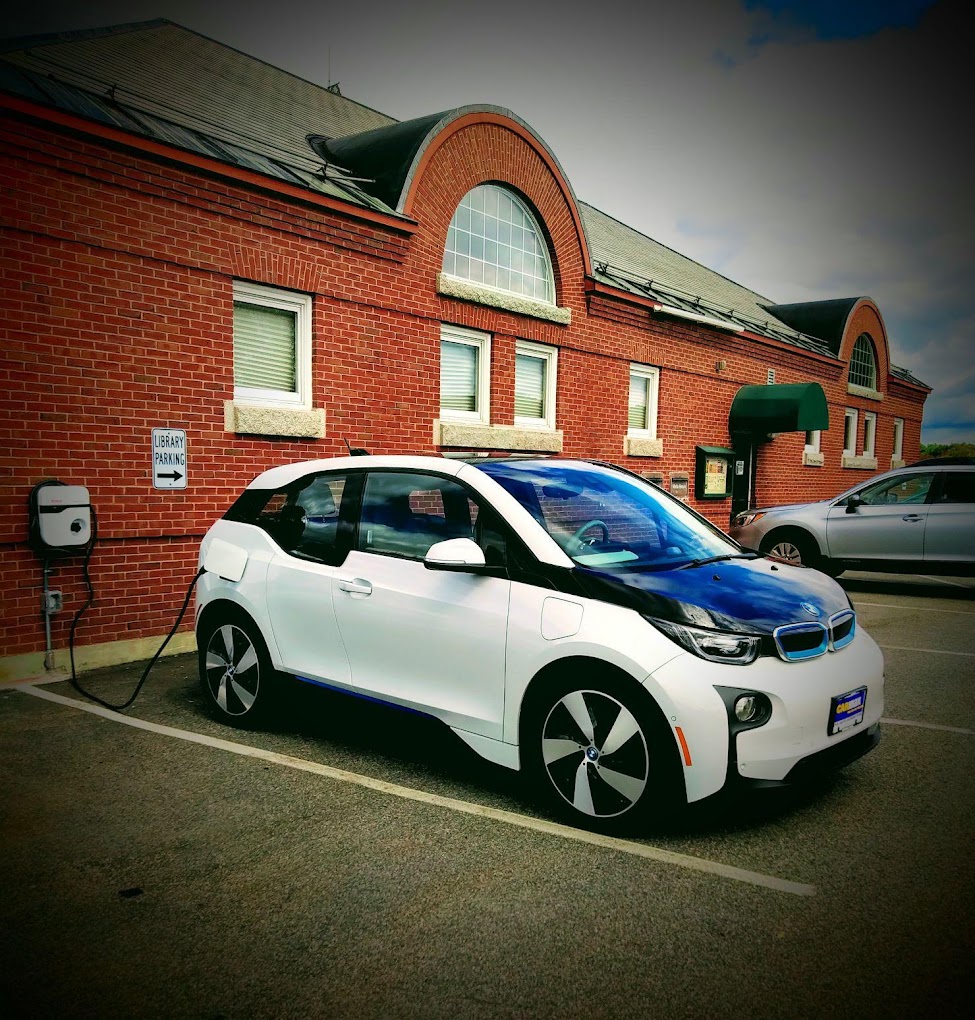
A wider and stronger network of electric vehicle charging stations is needed to support the growing electric vehicle sector. In March 2025, New Hampshire had 284 public electric vehicle charging locations, the fewest locations in New England.[i] Charging locations are strategically located along the major interstate highways, I-89, I-93, and I-95, and in major urban areas. The New Hampshire Department of Transportation (NHDOT) is expected to continue to enhance the charging infrastructure along the major travel corridors of I-93 and NH-16.
[i] US Department of Energy, Office of Energy Efficiency and Renewable Energy, Alternative Fuels Data Center, https://afdc.energy.gov/ , NH State Data accessed March 2025.
Connectivity Goals:
- Support an integrated multimodal transportation system to reduce vehicle-miles-driven that includes increased walkability, encourages bicycles and other efficient modes of transportation, and creates a town public transportation service for all residents, such as a town-run rideshare service.
- Transition municipal fleet to all electric or plug-in hybrid.
- Provide opportunities for increasing the number of electric charging stations in town.
- Support regional, state, and national actions to reduce greenhouse gas emissions.
Affordability & Accessibility
An accessible community has an environment that is meaningful and usable for as many people as possible and where options for clean, renewable energy are made available to all residents regardless of whether they are businesses, individual homeowners, renters or members of a Homeowners Association. An affordable community is where people can live comfortably and where Newmarket businesses and residents of all income levels can participate in energy efficient programs.
Energy efficiency and conservation are often the most affordable and accessible measures that can be undertaken to reduce energy consumption. These efforts focus on one main objective – reducing overall energy consumption across all sectors, thus reducing energy costs and environmental pollutants. Energy audits are one tool that all sectors can use to establish a base line of energy consumption, and based on the results, create a plan that can reduce energy consumption and costs over time.
One of the Town of Newmarket’s goals is to reduce the town’s carbon footprint and aspire to achieve 100% reliance on renewable and carbon neutral sources of electricity for municipal facilities by the year 2030 and 100% reliance on renewable and carbon neutral sources of fuel for heating by 2050. The Town owns, operates and maintains a variety of public facilities to support its residents. These facilities include the Department of Public Works/Fire & Rescue, Police Department, Town Hall, Community Center, Library, Sunrise-Sunset Senior Center, Transfer Station, Wastewater Treatment Facility, pump stations, water treatment plant, as well as a number of municipal wells [link to the Community Facilities Chapter for more details]. Other facilities that consume electricity include outdoor street lighting, traffic lights, electric vehicle charging stations, Macallen Dam, emergency services dispatch, and municipal parks such as Arbor Park, and Heron Point Sanctuary.
Although the energy used in municipal operations is minor compared to that of the residential and commercial sectors, Newmarket municipal facilities should lead by example and reduce the energy used in its buildings and operations, outdoor lighting, and vehicle fleet. Energy improvements will save taxpayer dollars and will create a model for businesses and residents to adopt. In 2018, the Town worked with ENE Systems and EEI (Energy Efficient Investments, Inc) to conduct an energy audit at five municipal buildings: Town Hall, Public Works/Fire & Rescue, Police Station, the Sunrise-Sunset Senior Center and the Library. The audit consisted of an initial energy assessment, site visit, and analysis of the utility and operational costs of the facility.
The audit found opportunities for the Town to find efficiencies in operations through upgrades to LED lighting with Smart controls, upgrading heating and cooling systems, insulating attics and pipes, and installing direct digital controls (DDC) which are automated systems that use sensors and digital devices to monitor and control building systems such as HVAC, lighting, and security. The audit also recommended the installation of a 50kW solar photovoltaic system on the Public Works/Fire facility. Following the assessment, the consultants developed a project plan for each facility that, when implemented, would increase energy conservation and reduce annual energy expenditures. To date, LED lighting and DDCs recommended in the audit have been installed in all 5 municipal buildings, and a solar system was added to Fire & Rescue facility in 2019. The recommendations are evaluated and added as systems are replaced or upgraded and budget allows.
In 2021, the Newmarket Environmental Services Water and Wastewater Departments studied electricity usage and identified potential efficiencies. These included operational water system measures such as improvements to the wells, upgrades to thermostats, pumps, and installing heat pumps. Improvements to the wastewater system included installation of thermostats, improved system ventilation, and upgrades to heating systems. When implemented, the potential electric energy savings is approximately 16% annually for water systems and 8% annually for wastewater systems with a potential annual savings of $20,000 (see Appendix A for summary tables).

The Town should continue to conduct audits of additional municipal operations including buildings, street and outdoor lighting, water and sewer, and transportation options; and formulate plans to upgrade town operations to the most efficient methods, materials, and technologies, as well as create a standard of efficiency for town operations moving forward.
The Town has been able to consistently track energy use and costs for five municipal facilities: DPW/Fire & Rescue, Police Station, Sunrise Sunset Senior Center, Town Hall, and the main building of the Community Center.
A baseline table for 2023 and 2024 can be found in Appendix A. To more effectively track energy usage and monitor the effectiveness of energy improvements, the Town should consider creating a dashboard that could track all municipal facilities and have a public-facing component that tracks key usage and cost metrics.
Over 50% of the respondents to the Master Plan survey indicated a high level of interest (extremely interested – 24% and very interested – 28%) in having the Town partner with energy professionals to offer energy efficiency audits to residents and businesses and to explore the creation of future tax incentive programs for energy efficiency improvements and renewable energy systems. Additionally, participants at the September 2024 Master Plan workshop indicated support for incentives for new construction and renovations to include the generation of electricity, energy efficiency, and heating/cooling from non-carbon-based sources (i.e. solar).
Affordability & Accessibility Goals:
- Audit Municipal operations including buildings, street and outdoor lighting, water and sewer, and transportation options; and formulate a plan to upgrade town operations to most efficient methods, materials, and technologies, as well as a standard of efficiency for town operations moving forward.
- Encourage business owners and residents to develop energy efficiency improvement plans.
- Encourage public and private participation in technical and financial assistance programs to reduce energy costs and consumption.
- Encourage transition to renewable heating sources.
Resiliency
A resilient community can withstand, recover or adjust to adversity or change and readily adapt to opportunities related to energy efficiencies and environmental change.
One of the actions that the Town of Newmarket has recently undertaken to be more resilient is to join the New Hampshire Community Power Coalition. Newmarket is a founding member of the Community Power Coalition of New Hampshire, created to enable communities across the state to access services, resources and to participate in joint power solicitations. Community Power is a program authorized under RSA 53-E to provide electricity supply service for the Town’s residents, businesses, and other types of customers, offering residential default rates that aim to be lower than or competitive with those offered by Eversource and provide a renewable energy content that is equal to or higher than Eversource. To the extent possible, Newmarket Community Power will aim to increase its renewable portfolio by 11% each year.
The Newmarket Town Council approved the Newmarket Community Power Electric Aggregation Plan in May 2023, and the Town launched Newmarket Community Power in March 2024. Newmarket’s Community Power Program operates on an “opt-in” or “opt-up” basis, allowing consumers to select a variety of renewable energy products up to 100%. The program operates on a competitive basis allowing customers to switch between power suppliers as desired. Newmarket’s goal is to increase its renewable portfolio by 11% each year. The Newmarket Energy and Environment Advisory Committee, also designated as the Community Power Electric Aggregation Committee, advises the Town Council about policies and services needed to implement and operate the program. The Town’s Electric Aggregation Plan can be found here: www.newmarketnh.gov/DocumentCenter/View/202/Newmarket-Community-Power-Electric-Aggregation-Plan-PDF
As of March 2025, after one full year of operation, Newmarket Community Power supports 73% of all electric accounts in Newmarket. Approximately 1% of the 4,089 Newmarket Community Power Accounts have currently opted for a higher level of clean energy over the default Granite Basic product which is composed of 24% clean energy. For those accounts that have selected a higher level of clean energy, in one year, they have eliminated an additional 48 tons of carbon emissions. With Newmarket Community Power we will have the opportunity to meet our renewable portfolio goal of 11% and reduce carbon emissions with minimal impact to Newmarket residents.
Another way that Newmarket can be resilient, maximize cost-efficiency and ensure more reliable energy security is to consider building municipally owned energy production as part of the Newmarket Community Power energy procurement. This could include town solar fields, retrofitting dams for hydroelectricity, or decentralized town solar arrays constructed on private property in public private partnerships. Respondents to the Master Plan survey indicated a high level of interest (24% were extremely interested and 24% very interested) in Town development of municipally owned energy generation projects, such as solar arrays, dams or hydroelectric power, or others.
Resiliency Goals:
- Through Newmarket Community Power, launched in 2024 starting at 22% renewable portfolio, and the Community Power Coalition, support Newmarket’s own publicly owned electricity provider that provides a 100% renewable plan, and has a higher renewable portfolio for the default plan and comparable or better costs than Eversource.
- Determine priorities for sourcing different types of renewable energy, prioritizing actual renewable and carbon neutral or better energy generation, and including considering town owned generation projects.
Appendix
See Appendix D in the appendix document.